
Agent memory needs an inbox, not just a search box
The first test for agent memory is intake: can a messy input be accepted, normalized, reviewed, routed, and made searchable without losing accountability?
Most conversations about agent memory start at retrieval.
Can the agent search notes? Can it find related ideas? Can it answer from past context? Can it remember what happened last week?
Those questions matter. They are also downstream of a quieter failure:
How does the right context get into memory while work is happening?
If the answer is “copy and paste it later,” the memory will drift behind reality. That may be acceptable for a personal notebook. It is not enough for agents doing long-running work, handling large files, listening to events, or updating state from other systems.
An agent memory needs an inbox.
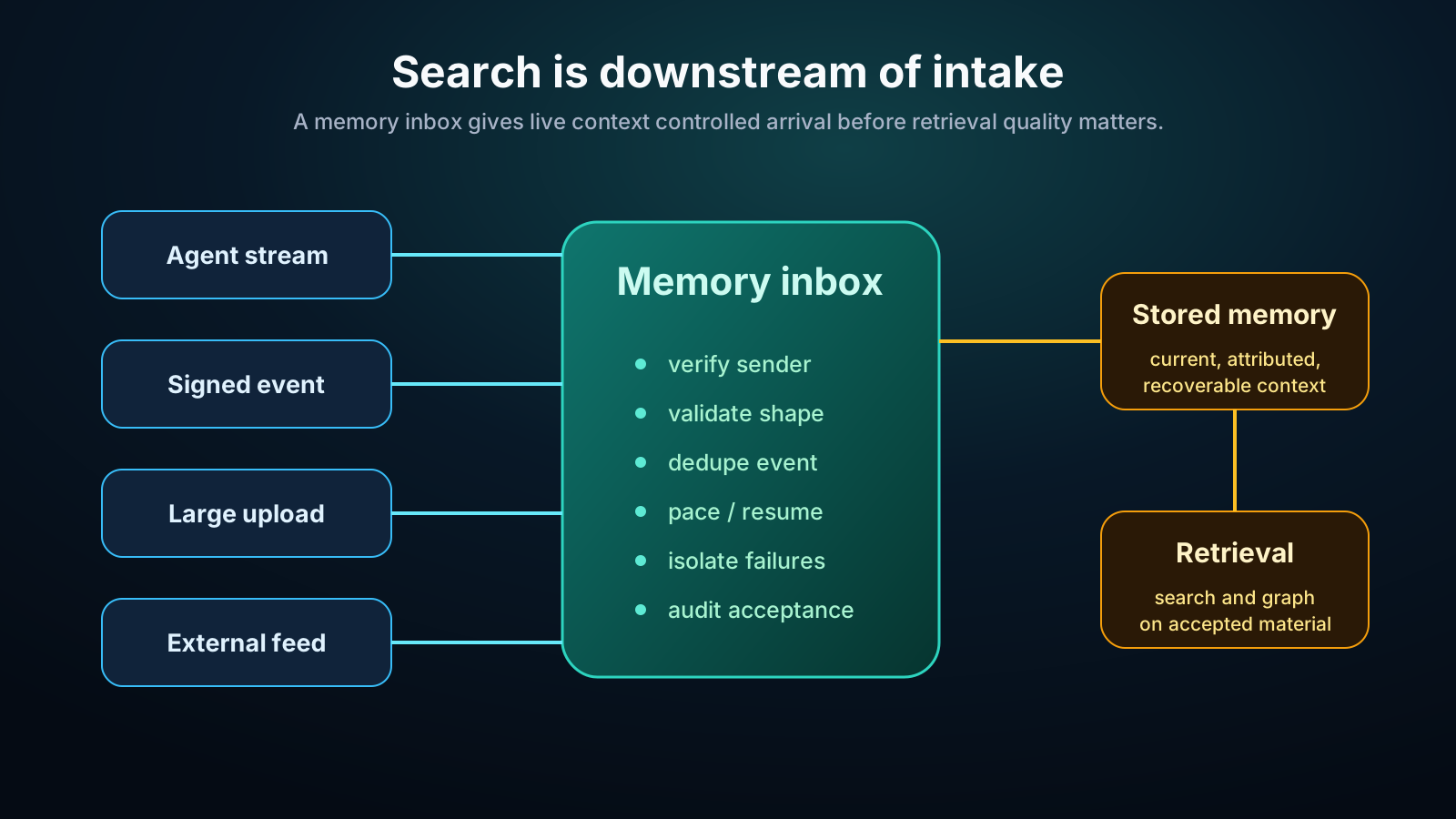
Illustrative inbox lanes: capture, normalize, review, and commit are separate responsibilities, not one opaque search action.
Try the ingest test
Pick one live source of context your agent should remember.
Make it concrete. Maybe it is a long stream of observations from a background task. Maybe it is a webhook from another app. Maybe it is a multi-gigabyte media file. Maybe it is an external event feed. Maybe it is a chat answer that should stream back while the system is still thinking.
Now ask:
1. Can the memory accept it while work is happening? 2. Can it verify the sender, route, or shape of the event? 3. Can it avoid storing duplicates when the same event arrives twice? 4. Can it pace a long stream without overflow? 5. Can it resume after a dropped connection or interrupted upload? 6. Can one bad event fail without blocking the rest? 7. Can an operator later see what was accepted, rejected, retried, or ignored?
If those questions sound operational rather than glamorous, that is the point.
Memory becomes useful when ingest is boring and reliable.
Search is downstream of intake
A search box can only find what made it into the system.
For personal notes, manual capture may be enough. For agentic work, it usually is not.
An agent may run for hours and learn in small increments. A customer system may emit events in bursts. A file upload may fail halfway through. A chat interface may need to show an answer as it arrives. A feed may need to catch up after a restart. A background process may need to append observations without waiting for a human to open the app.
If the memory only accepts clean, small, manual inputs, the retrieval layer can look better than the underlying truth. It will retrieve stale context perfectly.
That is the wrong victory.
The first serious question is not “how good is semantic search?” It is “what paths can safely add new knowledge?”
What a real memory inbox has to do
A useful memory inbox needs several lanes.
It needs live chat replies, so a person can see the answer arrive rather than wait for an opaque final blob.
It needs a secure external drop box, so trusted systems can post events without turning every integration into a custom import script.
It needs streaming note ingest, so an agent can pour in a long sequence of observations and get pacing instead of overflow.
It needs resumable large uploads, because real media and archive files are not polite.
It needs event-source connectors, so external systems can feed memory without manual copy-paste.
It needs failure isolation, so one malformed payload does not poison the whole lane.
And it needs privacy and audit discipline: logs and errors should not casually expose the material the memory is supposed to protect.
None of these are decorative features if memory is part of an operating system for agents. They are the ingest side of trust.
The safety detail matters
An inbox creates risk.
If other systems can send data in, the memory has to decide what to accept. That means signature checks where appropriate. Shape validation. Idempotency keys so repeated events do not become repeated facts. Durable logs. Backpressure. Dead-letter handling. Safer errors. Startup refusal when configuration is unsafe.
The human version is simple: do not let the memory become a junk drawer.
The engineering version is more specific: every incoming lane needs a way to prove what arrived, when, from where, and whether it was accepted.
That is why the ingest story connects to provenance, not just convenience. “We captured it” is weaker than “we can explain how it arrived and what happened to it.”
What this enables
Once memory has an inbox, the system can stay current without making the operator the integration layer.
An agent can stream what it learns as it learns it.
Another app can send signed updates.
A large file can resume instead of starting over.
An event feed can catch up after a restart.
A human can ask a live question and see progress.
Then retrieval has better material to work with.
The value is not “more data.” More data can make a memory worse. The value is controlled arrival: accepted, paced, resumable, auditable context.
Fortemi as the inspection surface
Fortemi is useful to inspect because its server direction is not only about storing knowledge after someone manually submits it. Its memory story includes API and MCP surfaces, streaming chat responses, webhook-style ingestion, streaming note intake, large-file upload paths, event-source processing, and provenance-aware knowledge structures.
The public claim should stay bounded: Fortemi is a concrete implementation surface for evaluating ingest lanes, not proof that every agent-memory problem is solved by one server.
That is the right level of specificity. A builder can ask:
- Which context sources need to arrive without a manual paste?
- Which senders or shapes need verification?
- Which events need idempotency?
- Which uploads need resumability?
- Which failures need isolation?
- Which logs need to prove acceptance without leaking sensitive content?
Those questions make “agent memory” easier to evaluate than a generic retrieval demo.
The smallest useful next step
Map one source your agent memory should ingest today.
Do not start with search quality. Start with intake:
- What sends the data?
- How do you know it is allowed?
- What happens if it repeats?
- What happens if the stream breaks?
- What record proves the memory accepted it?
- What is the safe failure path?
If your current system answers those questions, document the lane and keep using it.
If it cannot, the memory does not need a better demo yet. It needs an inbox.
Inspect the Fortemi server as one concrete implementation model, then test the idea against a real source of context.